Weather at the Crater Rim
Ticket, shuttle or tour?Everyone walks the last stretch: the Gran Cono path from the car park at about 1,000 m to the crater rim, on a timed ticket bought in advance. What you choose is how you reach the car park — on your own, by shuttle from Pompeii or Ercolano, or on a coach from Naples — and whether Pompeii or Herculaneum comes with it.
Compare the optionsHow much colder, and why
The 6 to 8 degrees is a rule of thumb, not a Vesuvius measurement: it is the standard rate at which air cools with height, applied to the climb from sea level to the path. On the day, sun, wind and cloud move it either way. Travellers describe it as very cold at the top in winter and hot in summer, and both are true. I have stood on the rim in January in a hat and gloves, and walked up in August in a T-shirt that was soaked by the first kiosk.
Wind and dust
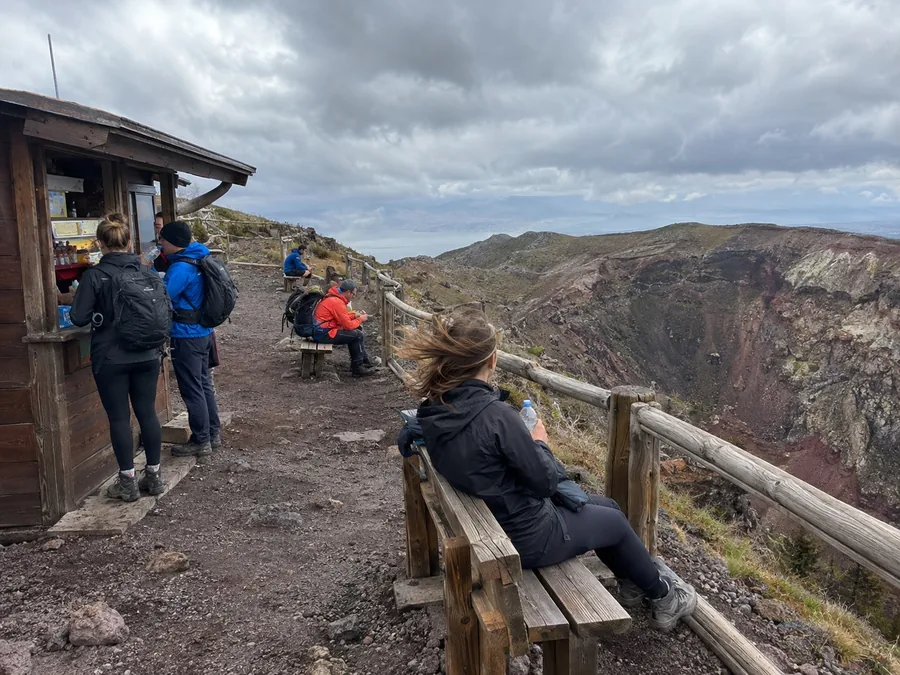
The rim is a ridge with nothing around it, so any wind from the sea hits it directly, and it picks up the fine ash. On a windy day the dust gets in your eyes and on your camera, and it feels much colder than the thermometer says. The park publishes no wind-speed limit. What closes the path automatically is a regional civil protection alert at orange or red, and beyond that the path can close at short notice in bad weather. Independent guides say closures are frequent when snow, heavy rain or gales make the ash slippery. What happens to your ticket then is on tickets and hours.
Heat and sun
The cone has no trees and no shelter until the kiosks at the top. Jens warned that at 30 °C and above the climb “can quickly become an ordeal”. The park publishes no heat rule, so on a hot day the decision is yours. In July and August I book the 09:00 slot, before the gravel has had the whole morning of sun, and I carry more water than I think I need. Drinks are sold at the stall at Quota 1000 and at the kiosks on the rim; I have never found a drinking fountain.
Cloud and fog
Cloud can sit on the cone while the coast is in sunshine, and when it does you see the crater edge and not much else. The view is most of the reward, so this matters. Michael’s advice was blunt: “If the weather isn’t good… skip the trip.” Look at the mountain itself from the coast before you set off. The Pompeii shuttle tour switches to the Herculaneum excavations when the park closes the path, which is a sensible fallback.
What to wear, season by season
- November to February (slots to 15:00): a warm layer and a windproof jacket, a hat, possibly gloves. Snow and ice can close the road above 800 m.
- March to May, October: a layer you can take off on the switchbacks and put back on at the rim.
- June to September: a hat, sunscreen, sunglasses against the dust, and plenty of water.
- All year: shoes with grip. No flip-flops.
Best months and hours
My own favourites are April and May, and late September into October: the air is cooler, the slots run until 16:00 or 17:00. Nick, in late September, called the weather “perfect”. July and August are the longest days, to 18:00, and the hottest walking. Winter is quieter, colder and shorter, with the last slot at 15:00. How the time adds up is on how long the hike takes.
Check two things the evening before: the regional weather alert and whether the cone is forecast to be in cloud. Either one can make the trip pointless.
If the forecast looks good, book a slot on the ticket alone. Check the cancellation terms in the booking box; the ticket-only listing says its tickets are non-refundable, while tickets for days the park closes are refunded by the park.
Frequently asked questions
Is it cold at the top of Vesuvius?
Usually colder than the coast. As a rule of thumb it is about 6 to 8 °C cooler at 1,000 to 1,175 m than at sea level, and the rim is exposed to the wind. In summer the sun on the path makes it feel hot anyway, because there is no shade.
What should I wear to hike Vesuvius?
Shoes with grip, a layer or windproof jacket, a hat and sunscreen, and water. In winter add warm clothes and gloves. How demanding the walk is on how hard the hike is.
Does Vesuvius close in bad weather?
Yes. Sales and access close automatically on orange or red regional weather alert days, and the path can close at short notice in bad weather. Tickets for closed days are refunded automatically. What the park does to keep the walk safe is on is the walk safe.
What is the best time of year to hike Vesuvius?
Spring and autumn are the most comfortable: cooler air and slots until 16:00 or 17:00. Summer has the longest hours but the hottest walk; winter is quiet but cold, with the last slot at 15:00.