Is Vesuvius Still Active?
Ticket, shuttle or tour?Everyone walks the last stretch: the Gran Cono path from the car park at about 1,000 m to the crater rim, on a timed ticket bought in advance. What you choose is how you reach the car park — on your own, by shuttle from Pompeii or Ercolano, or on a coach from Naples — and whether Pompeii or Herculaneum comes with it.
Compare the optionsActive, not extinct
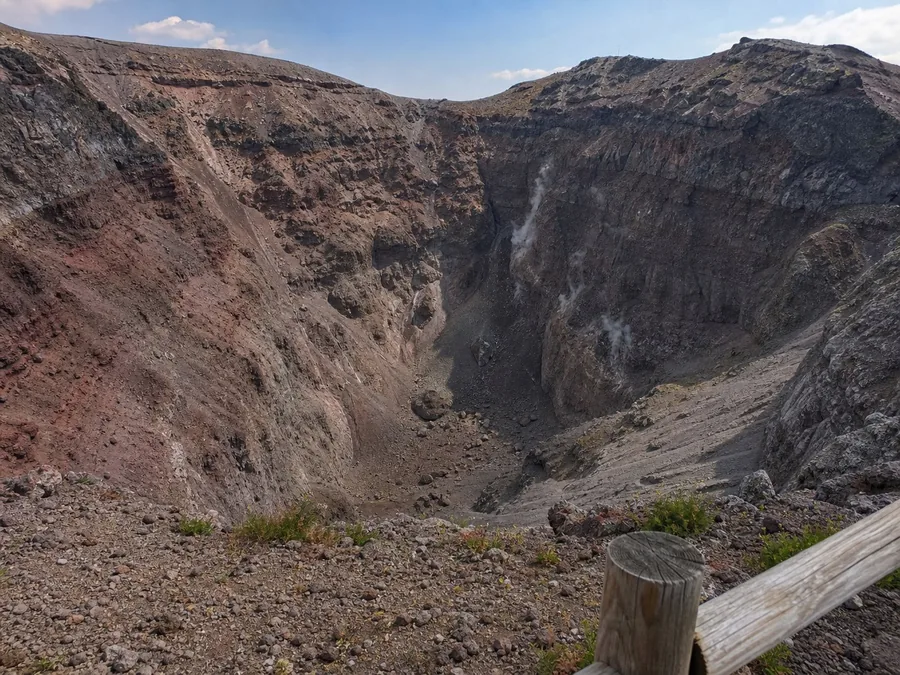
The park describes Vesuvius as active but at rest. The signs are small: fumaroles on the inner walls of the crater and frequent earthquakes too small to feel. INGV dates the present phase to April 1944, when the crater was blocked at the end of the last eruption; it calls this the closed-conduit period. “Dormant” is a loose popular word for it. “Extinct” is wrong.
What the monitoring shows
The Osservatorio Vesuviano was founded in 1841 and is described by INGV as the oldest scientific institution dedicated to volcanoes. Its old building on the slope is now a museum; the monitoring runs from INGV’s centre in Naples. The August 2026 bulletin recorded 112 small earthquakes, the largest magnitude 1.6, most of them within the first kilometre under the crater. It found no ground deformation from magma, stable crater temperatures and a decline in hydrothermal activity that has run for several years. The current figures are on INGV’s Vesuvius status page.
There are four alert levels: green (base), yellow (attention), orange (pre-alarm) and red (alarm). The Dipartimento della Protezione Civile decides any change, based on INGV’s monitoring.
Will it erupt in 2026?
No official source forecasts an eruption. The Civil Protection position is that, with current knowledge, the timing of a reactivation cannot be established precisely; what the monitoring would do is show the signals changing, and the alert level would move up through yellow and orange. It also says that if signs of reactivation appeared, they could not tell in advance what type of eruption would follow. I grew up in Torre del Greco, one of the red-zone towns, and I do not forecast either.
The red zone and the 72 hours
The national plan covers a red zone of 25 municipalities in the provinces of Naples and Salerno plus three districts of the city of Naples, home to roughly 670,000 to 700,000 people (official pages give both figures). Red zone 1 is the area exposed to pyroclastic flows; red zone 2 is where roofs could collapse under ash. A wider yellow zone of 63 municipalities and three more Naples districts is at risk of heavy ash fall. Each red-zone town is twinned with an Italian region that would take in its residents.
The strategy is a preventive evacuation of the red zone when the red, alarm level is reached, carried out over a 72-hour window with all towns leaving at once. The 72 hours is the time allowed to evacuate, not a promise that scientists can predict an eruption 72 hours ahead. The plan is built on a sub-Plinian eruption like that of 1631; see the Civil Protection plan for Vesuvius.
Would Naples be destroyed?
Central Naples is roughly 13 to 15 km from the crater. Three of its eastern districts are in the red zone and three more in the yellow zone, so the plan treats parts of the city as exposed. The reference scenario describes an eruption column, heavy ash spread over tens of kilometres and pyroclastic flows down the slopes of the volcano. Which way the ash would fall depends on the wind on the day, which is why nobody can say more than that. In AD 79 Neapolis, upwind, was spared the worst; that story is on the eruption of AD 79.
The last eruption, in 1944
INGV dates the eruption from 16:30 on 18 March 1944. Lava flowed towards San Sebastiano al Vesuvio and Massa di Somma, partly destroying both, and on 21 and 22 March lava fountains rose up to about 4 km. Explosive phases followed, with ash and lapilli falling on towns to the south-east, including Terzigno, Pompei, Scafati and Nocera, until the explosions stopped on 29 March. About 10,000 people were evacuated, according to INGV; other sources say about 12,000.
A few dozen people died, mostly when roofs collapsed under the weight of ash. The sources do not agree on the number: INGV’s account mentions 21 deaths on 26 March alone and 23 from roof collapses, and other sources give 26 or 47 (INGV’s account of the 1944 eruption). At the US air base near Terzigno, hot ash damaged or destroyed around 80 B-25 bombers, without deaths there. The eruption with thousands of deaths was the one in 1631, with around 3,000.
Vesuvius is not Campi Flegrei
Most earthquake headlines from Naples in 2024 to 2026 are about Campi Flegrei, a separate caldera west of the city around Pozzuoli. It has been at yellow since 2012, the ground there has been rising since 2005, and it produced earthquakes of magnitude 4.6 in March and June 2025 (INGV’s Campi Flegrei page). Vesuvius, east of Naples, has stayed at green, and the crater walk is not affected by the Campi Flegrei alert. What that means on the path is on is the walk safe.
The path is open at green, on a timed ticket. Check the cancellation terms in the booking box; the ticket-only listing says its tickets are non-refundable.
Frequently asked questions
Is Mount Vesuvius active in 2026?
Yes, it is an active volcano, but in a quiet phase since 1944. INGV keeps it at the green, baseline alert level; its August 2026 bulletin showed small earthquakes and no deformation from magma.
Is Vesuvius likely to erupt soon?
No official source forecasts an eruption. Civil Protection says the timing of a reactivation cannot be established precisely; if the monitoring signals changed, the alert level would rise through yellow and orange before any evacuation.
Can Vesuvius ever erupt again?
Yes. It is active, which is why it is monitored continuously and why a national evacuation plan exists for the roughly 670,000 to 700,000 people in the red zone.
How many people died in the 1944 eruption of Vesuvius?
A few dozen, mostly when roofs collapsed under ash. The figures vary between sources: 21, 23, 26 and 47 are all quoted. The eruption of 1631 killed around 3,000; AD 79 is on the eruption of AD 79.
Would Naples be destroyed if Vesuvius erupted?
Nobody can say in advance. Three eastern districts of Naples are in the red zone and three more in the yellow ash zone; central Naples is about 13 to 15 km from the crater. The plan is to evacuate the red zone before an eruption. The crater walk itself is covered on the complete hiking guide.